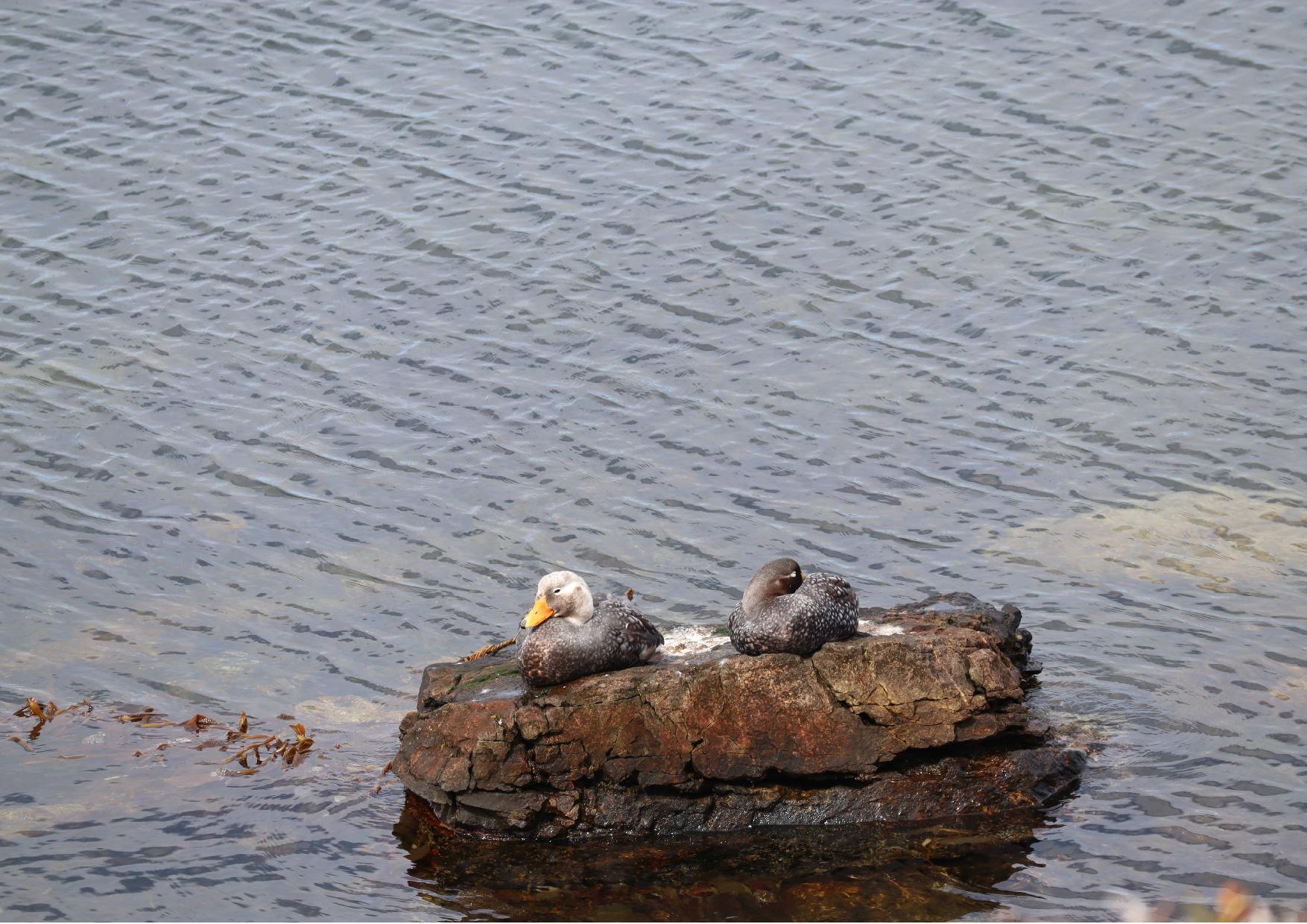
It is December and the first ducklings are starting to appear in the harbour! This is only the start as the Logger ducks do not breed exactly at the same time. For instance, we believe that they are a month ahead on Bleaker Island. The pairs are also not at the same stage of breeding. Here in Stanley, we found 11 nests. Only one has reached the hatching phase. But of course, we cannot keep an eye on every pair, especially not those whose nest might be in someone’s garden. For those, we must wait for the parents to bring their chicks by the water.
The first month was dedicated to characterising habitats that housed breeding pairs. For that, the topography and vegetation were recorded which included factors such as cliffs, grass and ferns. Additional information including access to freshwater were also noted as this is a valuable resource to any seafarer. The goal is to develop a model strong enough to predict what a good habitat looks like. And how to check if it worked? Through breeding success! - which brings us back to habitat quality. If the pair is living in a favourable habitat with little predation, we expect a clutch between 6 to 8 eggs. If food is also plentiful, then the clutch should hatch with all the ducklings fledging. Otherwise, there should be some loss at the different stages of the breeding season.
So far, we have successfully tagged 17 ducks. As we are the first to tag any individuals from the four species of Steamer duck, the data is ‘super cool’. The data collected have already told us that among the tagged birds, we unintentionally tagged a flying individual. This is clear from the fact that this duck spends most of its time by the Big Pond, on Bleaker Island. Life on freshwater is typical of the flying population while the flightless one thrives on the coastline. As such, each track reveals a fragment of the life of its owner, which makes it very exciting. The last aspect of the research we are conducting, started with Sébastien and now Heather is the curation of a scat collection. It does not sound very appealing but is full of promise. This will be one way of looking at the Logger ducks’ diet. Two strategies are currently in place:
1. Regular collection of scats from targeted breeding pairs. If any changes in the diet throughout the breeding season occurs, the collection should be able to capture it. We are collecting scats from both individuals and their chicks when possible. As the chicks are going through a downy then a juvenile plumage, do they feed on the same items as their parents? If not, what do they forage on?
2. Opportunistic scat collection across the Falklands. We are grateful to collaborating researchers who sample scats for us. The collection currently comprises scats from New Island and Sea Lion Island. By getting as many scats from as many places possible, a Falkland-wide understanding of what the steamer ducks consume can be obtained.
Overall, these last couple of months were busy. And so will the remaining ones! However, the data collection for the different chapters of the PhD is going smoothly. The only thing we could wish is less wind and more sunny days. Summer is on its way, so we will see!
Sébastien Dupray I had the chance of joining the Steamer Duck project at SAERI for a month. It has been a great experience for me, a first in the Falklands and hopefully not the last. The Falklands ecosystems didn’t cease to amaze me by their diversity of adaptations. Participating in the study of an endemic species, on the threshold of the flight adaptation loss was very interesting and insightful. I learned more about how to handle a waterfowl with great caution, and the possibilities and limits of studying them. I am very eager to see what will result from this study, and I do hope I will be able to come back next year for a new fieldwork season.
Heather Mathews Just over a month ago I joined Alix’s Steam Team and sat on Bleaker Island. Sheltered from the wind, we celebrated the first year of her PhD candidature. Working with Alix for the rest of this field season, I’ve had the opportunity to settle into island life. While the sweeping landscapes and rugged outcrops are reminiscent of my home near Dartmoor in the UK, the Falklands’ unparalleled abundance of wildlife are a sight I wish never to take for granted. The fondness in which the Logger duck is regarded by the community, highlights the enigma that these birds inspire, and questions we hope to answer. It is a pleasure to work with this charismatic species and I am looking forward to following their progress over the next few months. I’ve thoroughly enjoyed working with Alix so far and am looking forward to what the next few months bring!
Used to determine whether a user is included in an A / B or Multivariate test.
18 months
_ga
ID used to identify users
2 years
_gali
Used by Google Analytics to determine which links on a page are being clicked
30 seconds
_ga_
ID used to identify users
2 years
_gid
ID used to identify users for 24 hours after last activity
24 hours
_gat
Used to monitor number of Google Analytics server requests when using Google Tag Manager
1 minute
_gac_
Contains information related to marketing campaigns of the user. These are shared with Google AdWords / Google Ads when the Google Ads and Google Analytics accounts are linked together.
90 days
__utma
ID used to identify users and sessions
2 years after last activity
__utmt
Used to monitor number of Google Analytics server requests
10 minutes
__utmb
Used to distinguish new sessions and visits. This cookie is set when the GA.js javascript library is loaded and there is no existing __utmb cookie. The cookie is updated every time data is sent to the Google Analytics server.
30 minutes after last activity
__utmc
Used only with old Urchin versions of Google Analytics and not with GA.js. Was used to distinguish between new sessions and visits at the end of a session.
End of session (browser)
__utmz
Contains information about the traffic source or campaign that directed user to the website. The cookie is set when the GA.js javascript is loaded and updated when data is sent to the Google Anaytics server
6 months after last activity
__utmv
Contains custom information set by the web developer via the _setCustomVar method in Google Analytics. This cookie is updated every time new data is sent to the Google Analytics server.
2 years after last activity
Google reCAPTCHA helps protect websites from spam and abuse by verifying user interactions through challenges.
Name
Description
Duration
_GRECAPTCHA
Google reCAPTCHA sets a necessary cookie (_GRECAPTCHA) when executed for the purpose of providing its risk analysis.
179 days
Marketing cookies are used to follow visitors to websites. The intention is to show ads that are relevant and engaging to the individual user.
Google Maps is a web mapping service providing satellite imagery, real-time navigation, and location-based information.