


Fish & Ships: A bird’s eye view (Penguin News, May 22, 2020)
The aim of this PhD is to improve our understanding of albatross-fishery interactions in the Southwest Atlantic, focussing on the feeding ecology and demography of the world’s largest population of BBA. Specifically, this research focuses on the mitigation of harmful interactions with fishing gear, and establishing the importance of fishery discards to the diet structure and spatial distribution of breeding albatross.

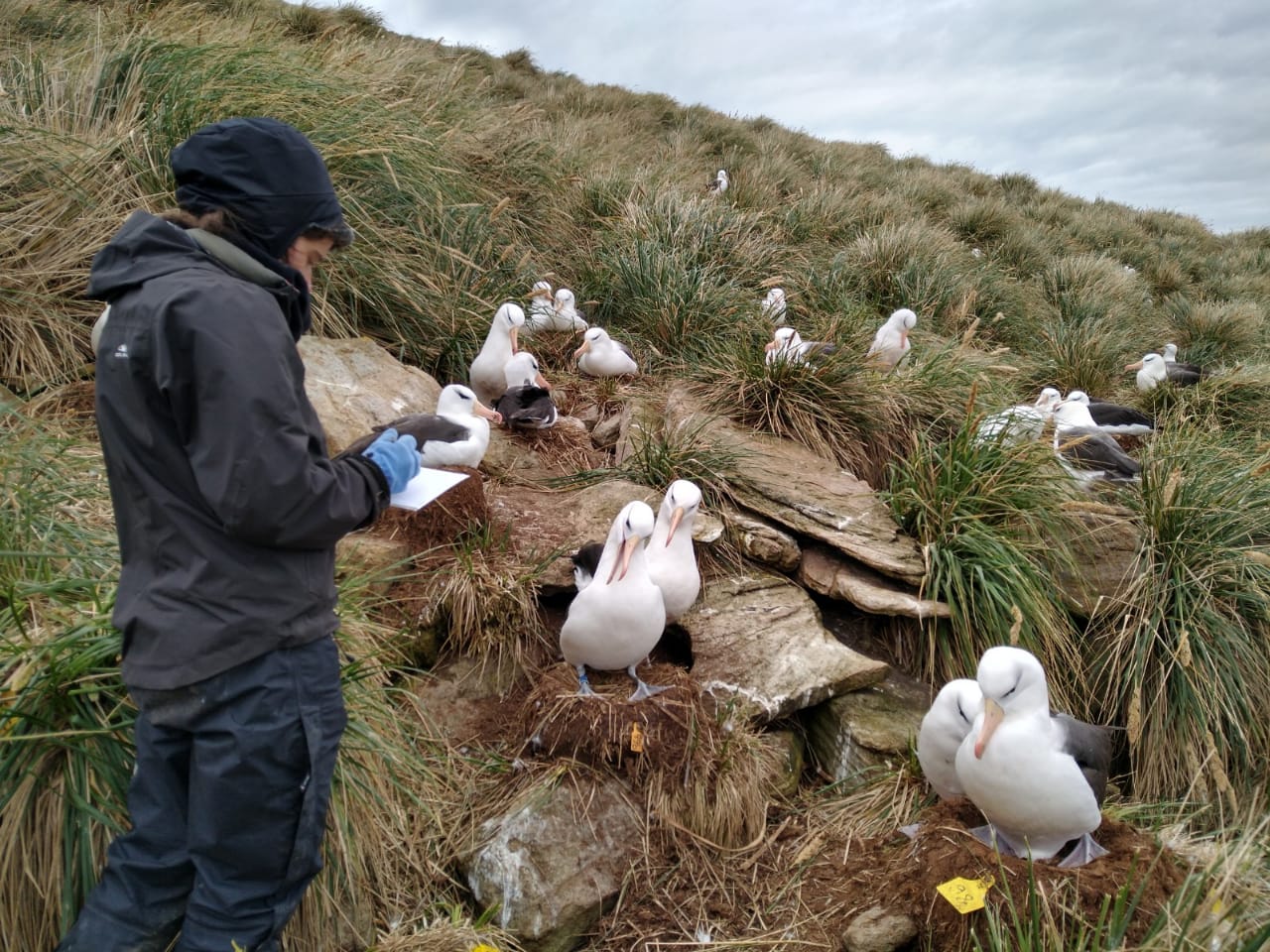

After completing my MSc in Marine Environmental Protection in 2012, I worked as Seabird Ecologist for the JNCC in the UK, identifying important at-sea habitat for various species of seabirds, and coordinating the UK Seabird Monitoring Programme. In 2015, I moved to the Falkland Islands to work as the Scientific Seabird Observer for the Falkland Islands Fisheries Department, where I collaborated closely with industry to improve seabird bycatch mitigation measures aboard the Falkland Islands trawl fleet. It is this work that formed the basis of my PhD, which I started in 2019.
Analysis and write-up of the discard management study were undertaken, with the manuscript submitted for peer reviewed publication in April 2021. Peer-review publication of this work is listed as a high priority under the Falkland Islands National Plan of Action for reducing incidental catch in trawl fisheries (Kuepfer et al., 2018, Objective 7.1).
The publication is now available as Kuepfer et al. (2022a).
https://www.sciencedirect.com/science/article/abs/pii/S0006320722000155
This study uses chick regurgitate data collected during eight seasons between 2004 and 2020. In 2020/2021, data collection and preparation were finalised, and data analysis and write-up undertaken. This study is now available as a peer-reviewed publication under Kuepfer et al. (2022b). https://academic.oup.com/icesjms/advance-article-abstract/doi/10.1093/icesjms/fsac069/6582866
Due to COVID-19 restrictions, the stable isotope samples collected in February and March 2020 were processed by a paid Assistant Researcher at the University between March and July 2021. NERC funding of approx. £5000 remained available for the analysis of the stable isotope samples.
The first two data chapters of this PhD were finalised and published
Chapter 2 found that bird abundance and gear collision rates were positively related. Compared to continuous discarding, batch discarding significantly reduced seabird abundance and gear collisions, while zero discarding eliminated gear collisions altogether. Our findings validate batch discarding as an effective seabird-bycatch mitigation measure in trawl fisheries where zero discarding is not possible, but highlight the importance of complete waste storage between batches.
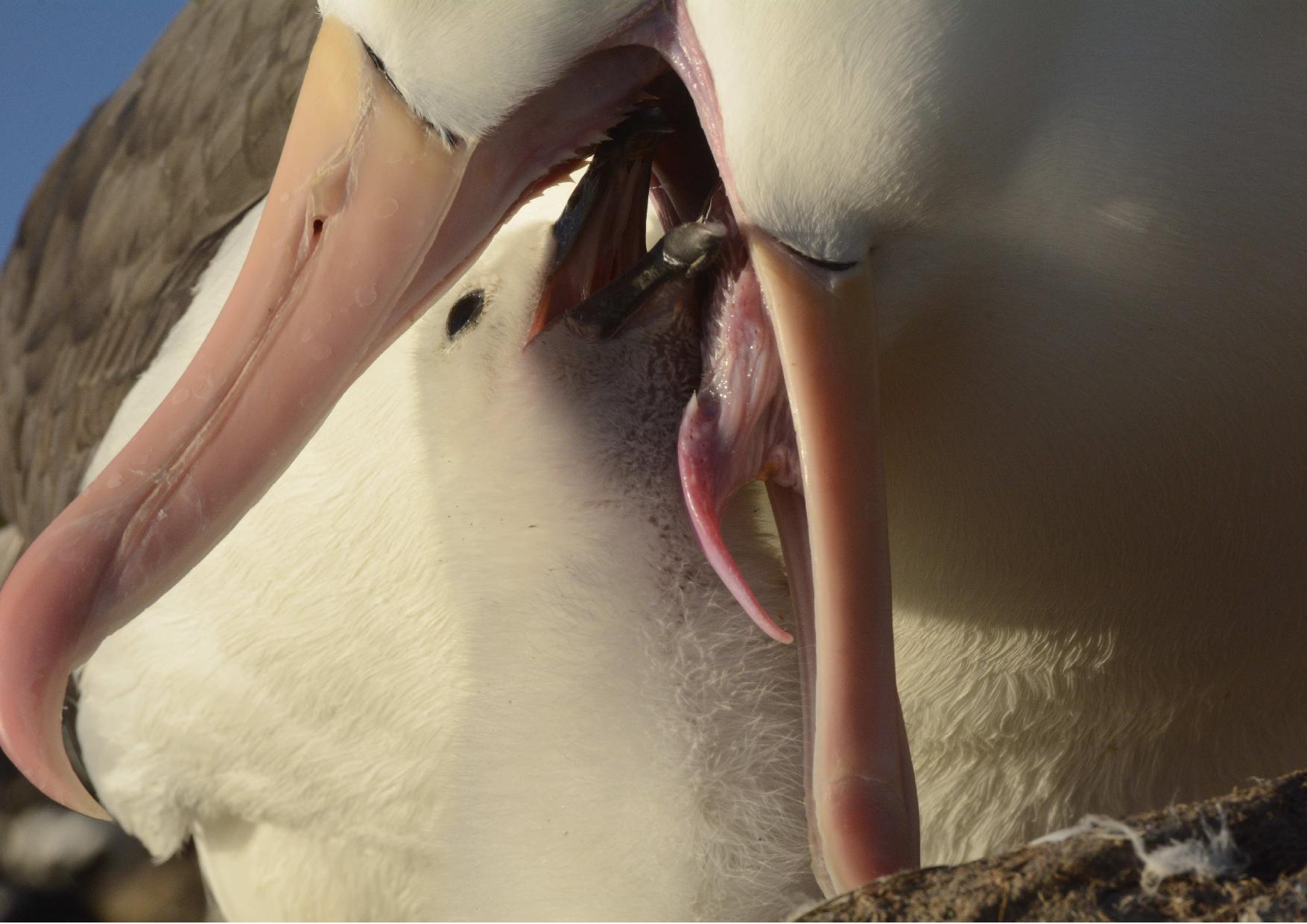
Chapter 3 showed that BBA chicks are primarily fed natural prey, but that discard consumption can vary significantly between years. Specifically, discard consumption was positively related to increased discard availability, but also increased in years of higher sea surface temperature and lower breeding success. Overall, the findings suggest that although natural prey are the preferred diet, BBA switch to discards when natural foraging conditions are compromised. While fishery discards may act as a buffer, we show that they do not compensate for poor natural foraging conditions for breeding albatrosses in the long term.
The third chapter of the thesis was finalised and published (See references above), and the final chapter was progressed:
Chapter 4 confirmed that chicks are predominantly fed natural prey during mid chick-rearing, but that there can nonetheless be important diet differences between colonies and years. Although discards were less important, we show that they are nonetheless taken regularly, thus exposing a large proportion of breeding adults to a bycatch risk. Combining SCA with SIA provided us with complementary information and helped with interpretation of results, but our study highlights that the optimal methodology is likely to be system- (and season-) specific.
Chapter 5 found that BBA foraging areas were generally characterised by productive shallow waters with enhanced mesoscale activity. These areas overlapped only moderately with fishing activity during both incubation and brooding stages, and did so predominantly with trawl fisheries operating within the Falklands Conservation Zones (FCZs) and the Argentine Exclusive Economic Zone (AEEZ)
