The Falkland Islands are home to >40% of the global Southern Giant Petrel population. Giant petrels play a key role in food webs as scavengers of wildlife and livestock, and influence disease transmission. However, the Falkland Islands giant petrel population remains virtually unstudied. This scoping study will be the first of its kind, providing baseline data on Falkland Islands giant petrel movements, enabling connectivity of the world’s largest southern giant petrel population to be assessed, and providing insights into potential routes of disease transmission. This scoping study will inform a comprehensive Highly Pathogenic Avian Influenza and scavenger movement project, which we anticipate will start in late 2025.
Whenever you attempt something for the first time, particularly with animal tracking, it is usually for good reason! Giant petrels that breed in the Falkland Islands are generally very shy, making them pretty challenging to capture. Nevertheless, we have made great progress to date, and with support from some fantastic colleagues, including Dr Amandine Gamble, we have been able to deploy a number of satellite tags. As figure 1 below highlights, some giant petrels are very local, while others range widely over the Patagonian Shelf. Giant petrels were captured at penguin colonies where HPAI was suspected or confirmed. Therefore, the tracking data provides valuable information on both scavenger movements and connectivity.
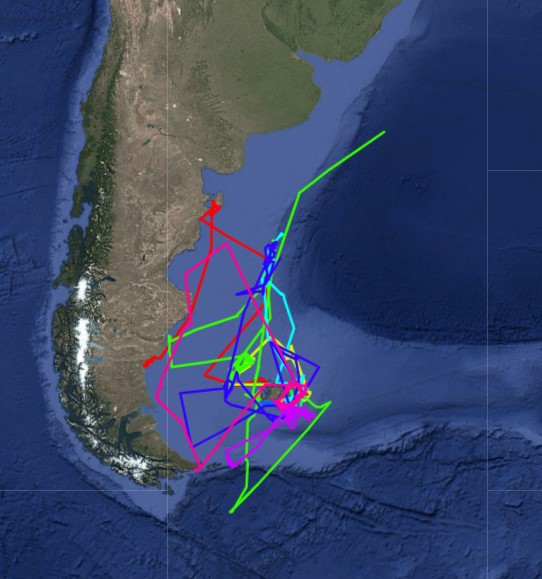
Fig 1. We tracked the movements of 10 Southern Giant Petrels from the Falkland Islands – the first time the species has been tracked in the Falklands! View the interactive map at the following link: https://my.wildlifecomputers.com/data/map/?id=673353f013a54786680d888a

Blog Post June 2025: Tracking the movements of Falkland Islands Southern Giant Petrels
This project is funded by the UK Government through Darwin Plus Local (project DPL00080) in partnership with Oregon State University