The Falkland Islands are home to >40% of the global Southern Giant Petrel population and they are a common site from land, as they soar along the coast looking for food. Like albatrosses, Southern Giant Petrels forage for fish and squid, but they also are adept predators and play a key role in food webs as scavengers. Their ability to quickly travel long distances and preference for eating dead things makes them likely to play a role in disease transmission. However, the Falkland Islands Southern Giant Petrel population remains virtually unstudied.

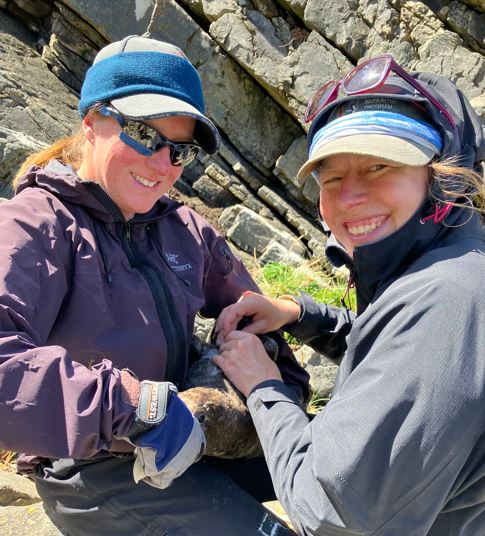
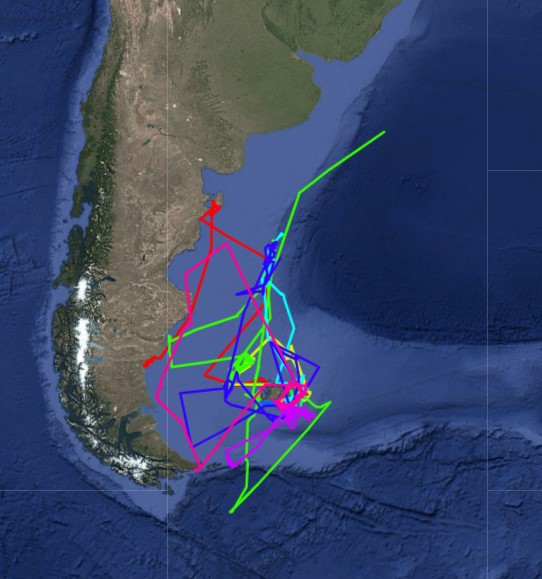
Fig 1. We tracked the movements of 10 Southern Giant Petrels from the Falkland Islands – the first time the species has been tracked in the Falklands! View the interactive map at the following link: https://my.wildlifecomputers.com/data/map/?id=673353f013a54786680d888a
With support from the UK Government Darwin Plus Local scheme, we undertook a scoping study to develop methods to track the movements of Southern Giant Petrels. By deploying satellite tags to monitor the movements of Southern Giant Petrels at-sea, we hoped to better understand the connectivity of the world’s largest population of Southern Giant Petrels, both within the Falkland Islands, and between the Falklands, South America and the Southern Ocean. In turn, this information will inform the potential role of Southern Giant Petrels in disease transmission and as key scavengers.
The first challenge was of course, catching Southern Giant Petrels. While in South Georgia you can easily approach Southern Giant Petrels, in the Falklands they are very wary of humans – especially humans carrying satellite tags. It took some trial and error, but by targeting efforts where Southern Giant Petrels were feeding on carcasses we were able to approach and capture birds effectively with minimal disturbance.
In total, we deployed 10 satellite tags as part of the scoping study (Fig 1). As expected, SGPs showed short-localized movements within the Falklands archipelago, with individuals foraging across East and West Falkland. Unexpectedly, we also documented multiple, often long-distance, pelagic foraging trips over the extent of the Patagonian shelf, including potential land-based foraging on the South American coast. As wide-ranging scavengers, the findings highlight Southern Giant Petrels are likely to play a significant role in connecting wildlife populations, both within the Falkland’s, and between the Falkland’s and South America. The pilot study supports the development of a larger HPAI-focused study on avian scavengers, which is planned to commence in the 2025/26 summer season, pending funding approval.
This research was funded by the UK Government through Darwin Plus Local scheme. Were indebted to Dr Megan Tierney for providing support and expertise in fieldwork.

