SAERI recently welcomed a work experience student, Ashan Molligoda from Braunton Academy in Devon who immersed himself in the world of environmental science during a hands-on placement in the Falklands Office.
Throughout his time with SAERI, Ashan assisted in a variety of tasks, gaining insight into the daily operations of a scientific research organisation. He joined project Managers Evan Langridge and Scott Leadbetter in the field doing work on the Diddle Dee project and learning to fly a drone. He also spent some time in the field with Dr Ko Nyein and Dr Al Bayliss learning about our Freshwater Project.
A highlight of the placement was an independent research assignment focused on two marine species of the South Atlantic: sea lions and fur seals. The student explored their habitats, behaviours, and conservation status, compiling their findings. The project not only deepened their understanding of marine mammals but also gave them valuable experience in scientific investigation and communication.
It was a pleasure to have such Ashan on board, and we hope this experience has inspired a future in environmental science!
The Difference between Fur Seals and Sea Lions in the South Atlantic
Ashan Molligoda
The South American fur seal (arctocephalus australis) and the Southern sea lion (Otaria flavescens) are the two types of seals that live in the South Atlantic. These two animals may seem similar on the surface, both being oratiids, and living in the same part of the world. However, they have some distinct differences.
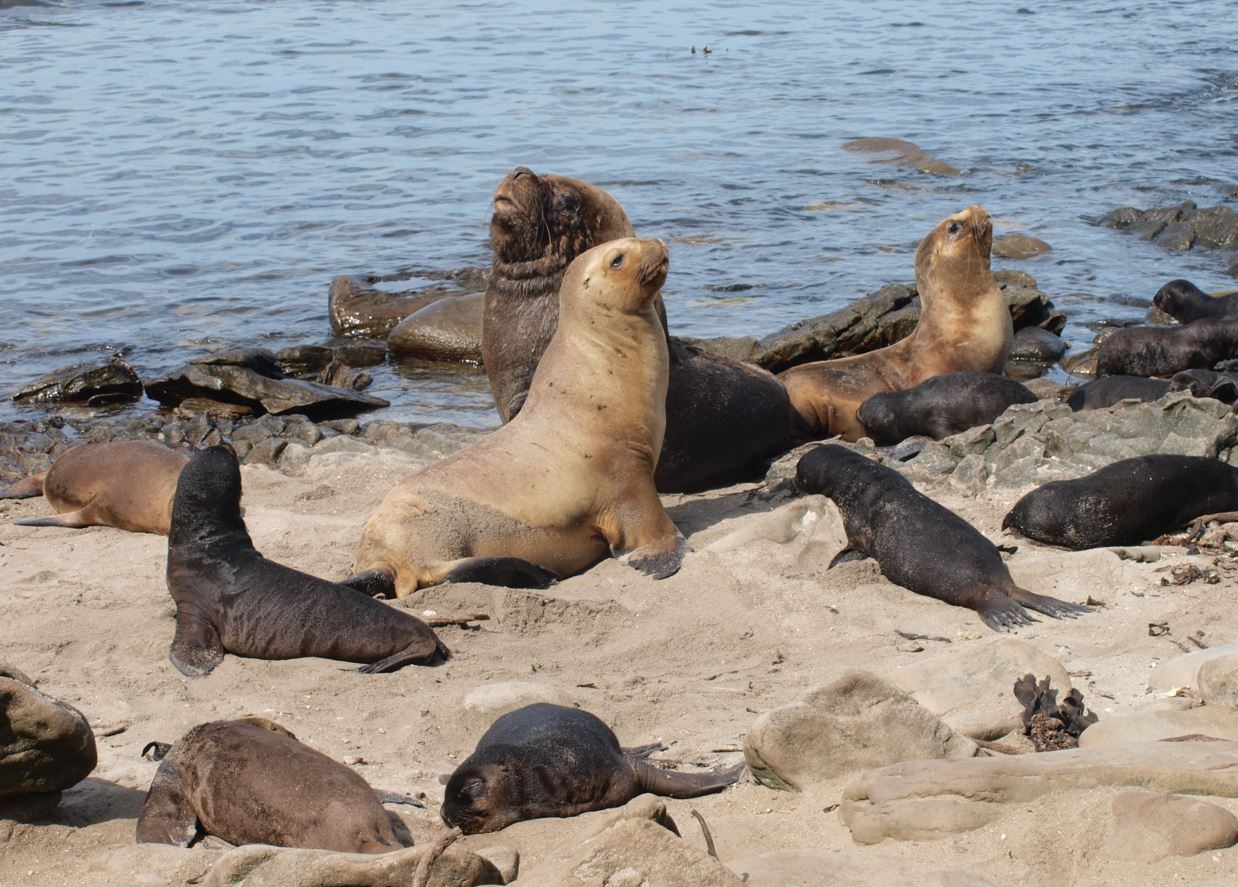
Southern Sea Lion (Otaria flavescens)

South American Fur Seal (Artocephalus australis)
In the Falklands, fur seals are more numerous than sea lions – with an annual pup production of about 35,000 fur seal pups, versus about 5,000 sea lion pups. However, fur seals tend to breed on remote offshore islands, so are not as regularly seen as sea lions, which often frequent Stanley Harbor and surrounds.
An obvious way to spot the difference between the two species is size. The South American fur seals are much smaller than their sea lion counterparts. A male/female sea lion being on average 1 metre and 160 kg/ 0.6 metres and 110 kg larger than their male/female fur seal. In particular, male sea lions have much larger necks and heads. This shows the different evolutionary pressures for strength (Southern sea lion) or speed (South American fur seal).
The Southern sea lion also has significantly larger flippers than the South American fur seals have with the sea lions being around double the surface area allowing for increased balance and mobility on land and impressive propulsion through water it also aids in temperature regulation. Fur seals having smaller flippers allows for better agility, speed, and precision by improving hydrodynamics in water that helps avoid predators and hunt prey.
Fur seals were hunted extensively in the 18th and 19th century because of their luxurious fur. Unlike sea lions, fur seals have both inner and outer guard hairs. In contrast, sea lions only have outer guard hairs, and rely much more on blubber as insulation, rather than hair.
