Before properly starting to write this update, I decided to write up a summary of what I have been working on since January to give me ideas on what to write, and then I had a quick look at what I wrote back in December. Both the summary and the last post were very much focused on lab work, specifically zooplankton DNA extractions and PCRs of those extractions, with a particular focus on fish larvae. I was also starting to do more detailed work on the Patagonotothen (rock cod) larvae DNA results, looking at their phylogenetics and how they all fit on a phylogenetic tree. It seems that my last 3 months has had much of the same focus, with an even more technical focus on the Patagonotothen barcode results (including checking any inconsistencies with the individual base pairs of the 620 base pair long DNA sequence for over 300 samples), which would not make for an interesting article! To make sure I’m not repeating myself, or boring anyone here, I thought it would be interesting to look at something completely different! (Though still zooplankton related, obviously).
The initial work I was doing on my PhD when I first arrived in the Falkland Islands (back in February 2023) was identifying zooplankton species under the microscope. As there is no existing list of the zooplankton species you might find in the Falkland Islands, I was looking in a very large number of scientific papers and at a lot of different taxonomic keys to try and identify the species that I could see. In some cases, I was identifying different ‘morphospecies’ (if an animal couldn’t be identified to a species level, I could still record the different distinctive morphologies of the organisms in the samples). My lab work in Aberdeen has been using DNA barcoding to try and identify any zooplankton species, or morphospecies, that weren’t covered by the taxonomic keys. Although the combination of techniques hasn’t managed to identify everything, I am now starting to put together a list of the species I can identify, and I have the morphological description for organisms that were seen, but I haven’t been able to find a species-level match, though this is still some information about the species.
What I would have found really useful when I started was a collection of diagrams for the species I might have in the samples. As anyone who saw me working at the microscope will know, whenever I saw a new organism, I would draw a diagram of it in my lab book, as I found this really helped me get my eye in to see the key features it had, which was especially important for closely related and morphologically similar species. Recently, I thought it would be fun to try and smarten up these diagrams, so I can try to put together all of the species identification information I have together in one place, complete with a morphological diagram. I’ve basically been putting together something past me wanted to exist (though I suppose if it had existed, there would have been far less work for me to do on this)! Hopefully other people are also interested in seeing a few diagrams of these microscopic animals.
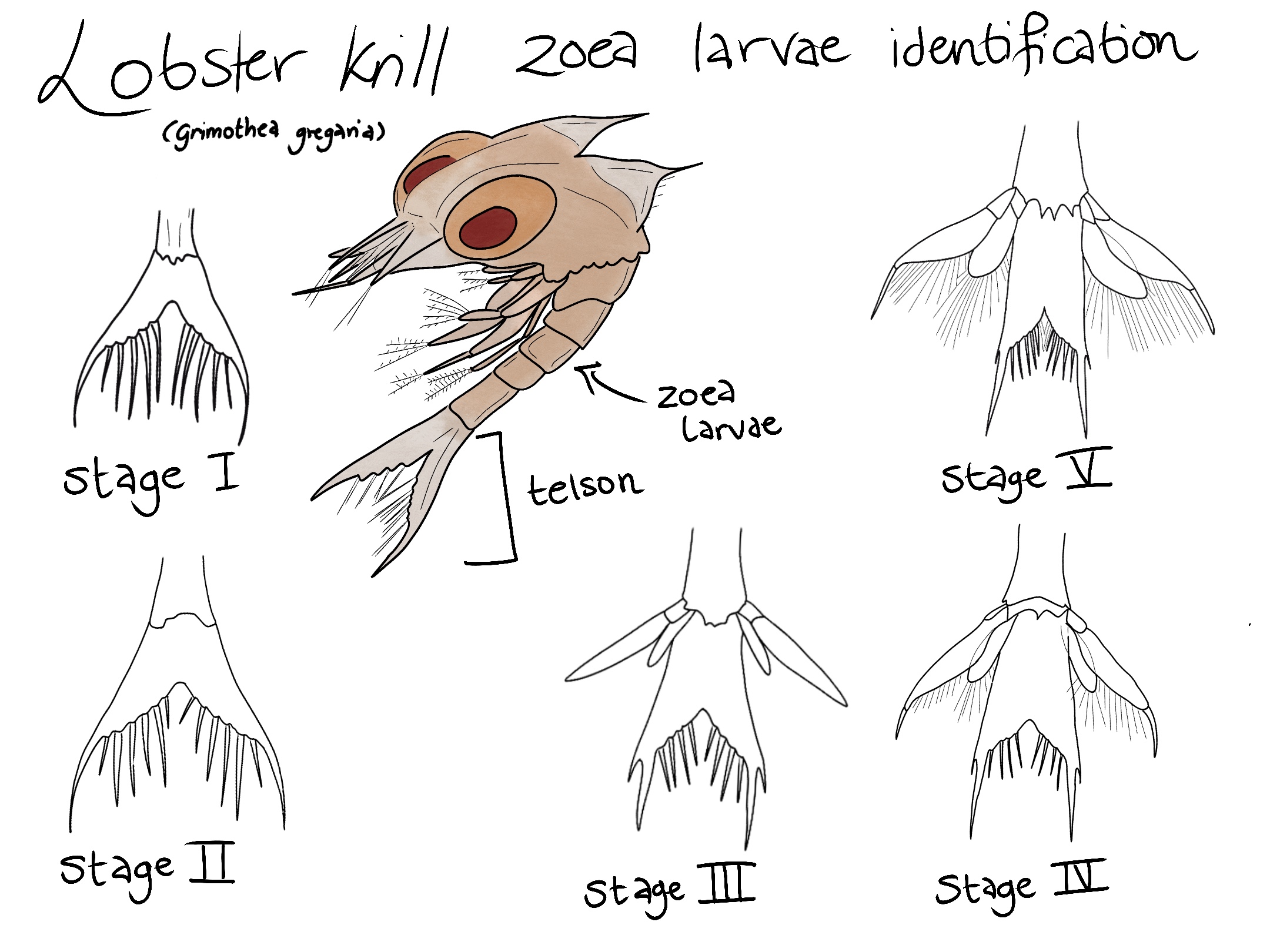
One of the most abundant species in my samples was Grimothea gregaria, or lobster krill – some people may be familiar with seeing the adults wash up on ‘red tides’, but I mainly had their larvae in my samples. Lobster krill go through several larval stages (5 zoea and 1 megalopa stage), before they moult into their post-larval form. When trying to identify the different zoea life stages, I found that the changes in the telson (the final abdominal segment of the larvae) were the easiest way to differentiate between each zoea stage.
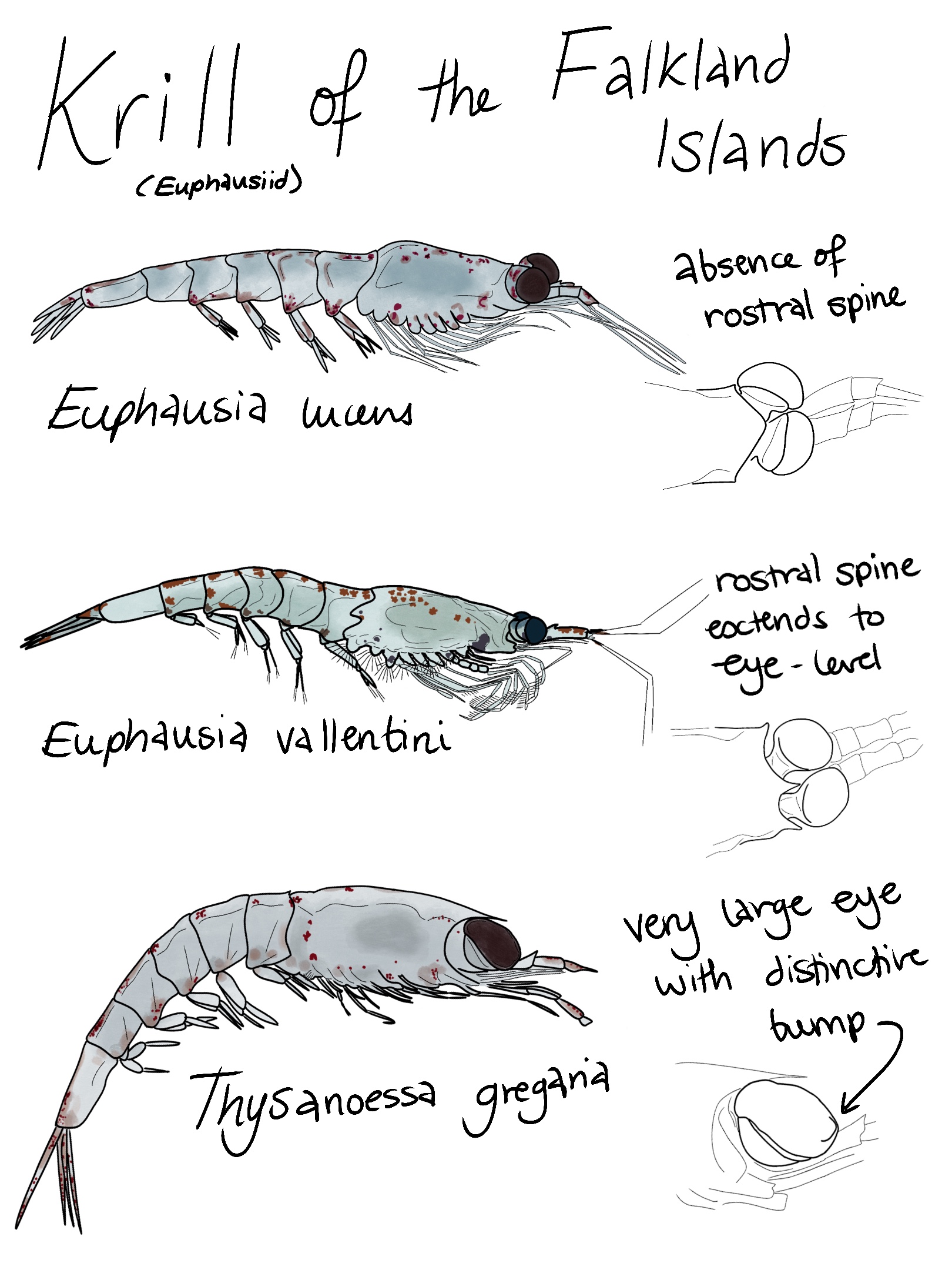
As well as lobster krill, I would regularly find actual krill in the samples. The most well-known krill species is the Antarctic krill, Euphausia superba, which funnily enough we do not have in the Falkland Islands, but I did regularly find three species other of krill – Euphausia lucens, Euphausia vallentini and Thysanoessa gregaria.
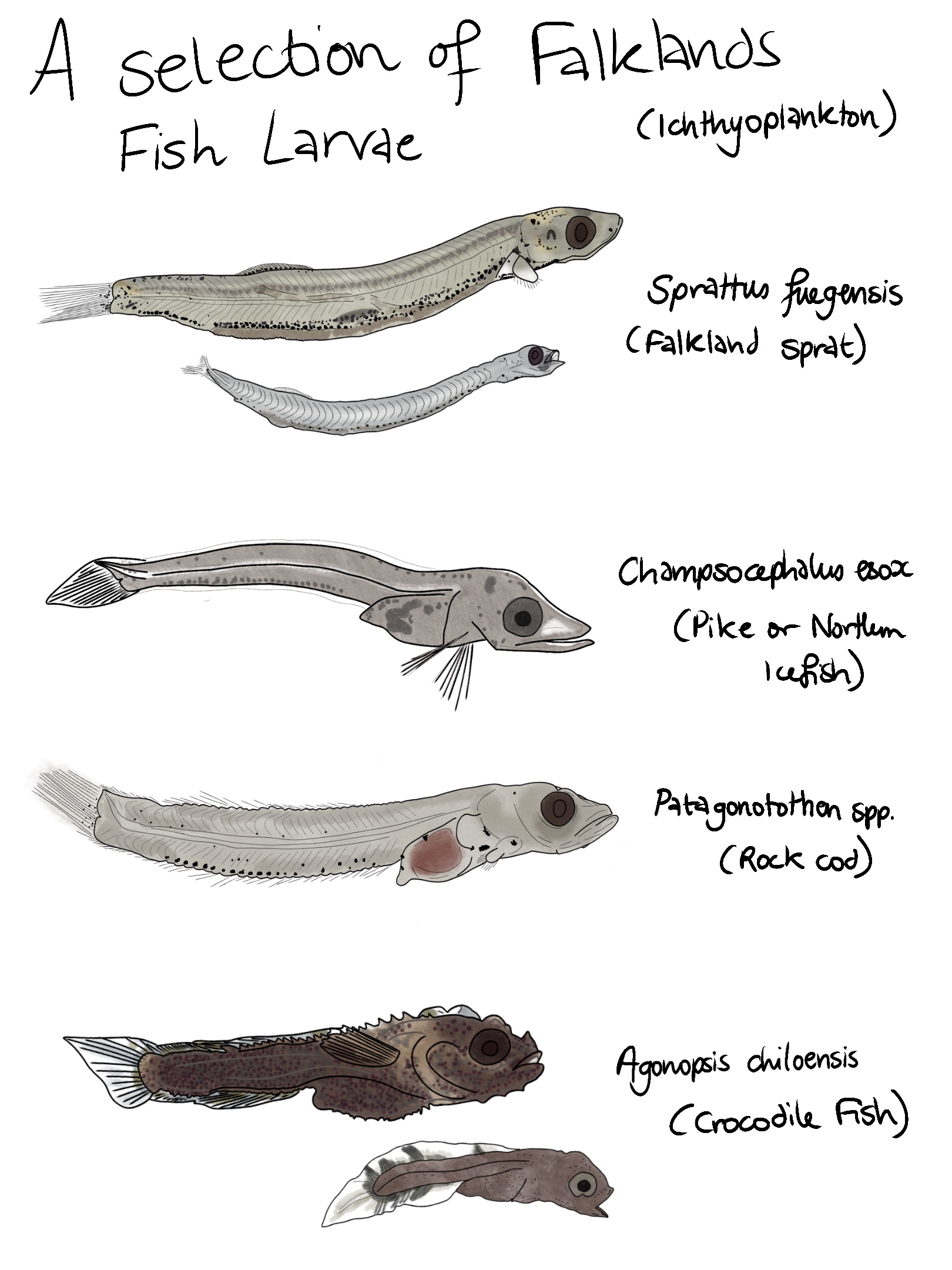
As I mentioned back in December, by combining the morphological information with the DNA barcode results, I have been able to identify the morphology of specific fish species, some of which are present at different life stages (and morphologies) at different times of year. I have been attempting to draw diagrams for each distinct morphology I have seen, even when they are for the same species, as hopefully this information will come in handy for someone at a later date!
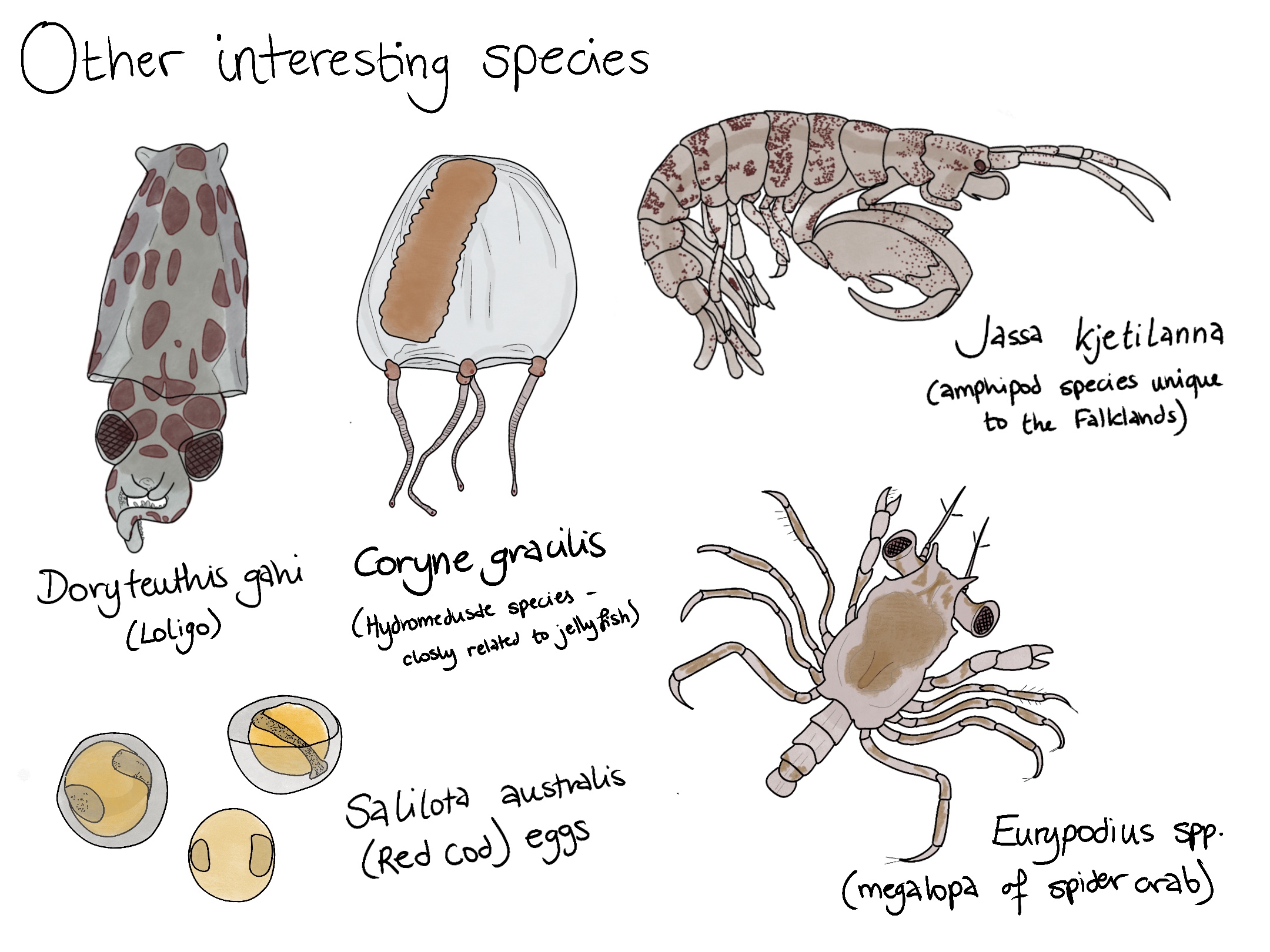
These diagrams are very much still a work in progress, and I’m still working out which species I still need to draw, and what identification information I need to put together for others. To finish up, here is a miscellaneous selection of zooplankton species, covering a few more of the diverse range of species and families present in the Falklands zooplankton community.