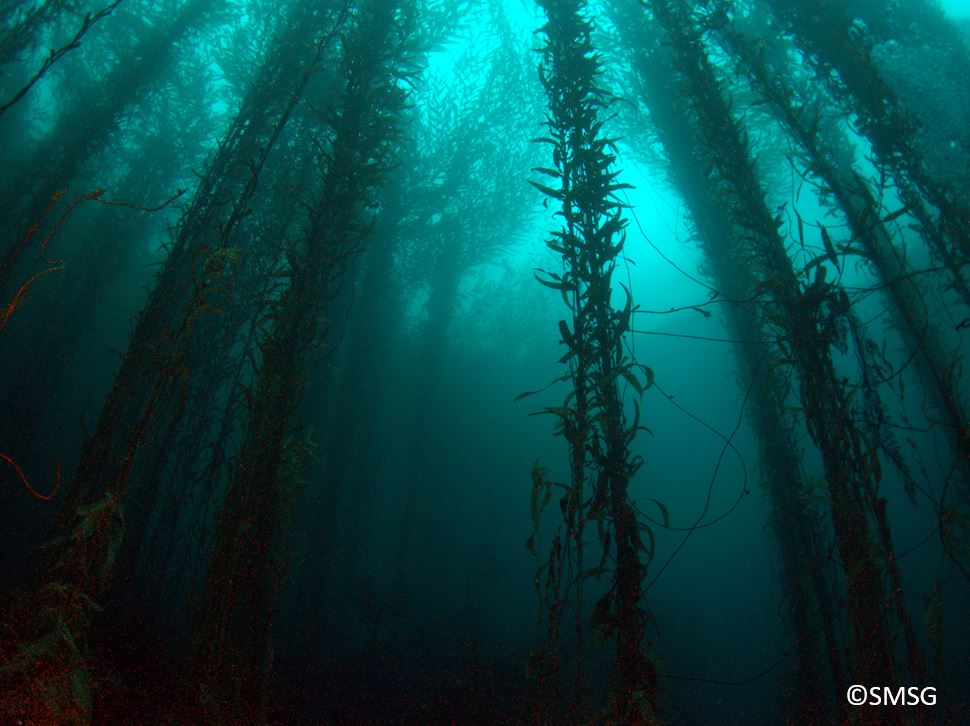
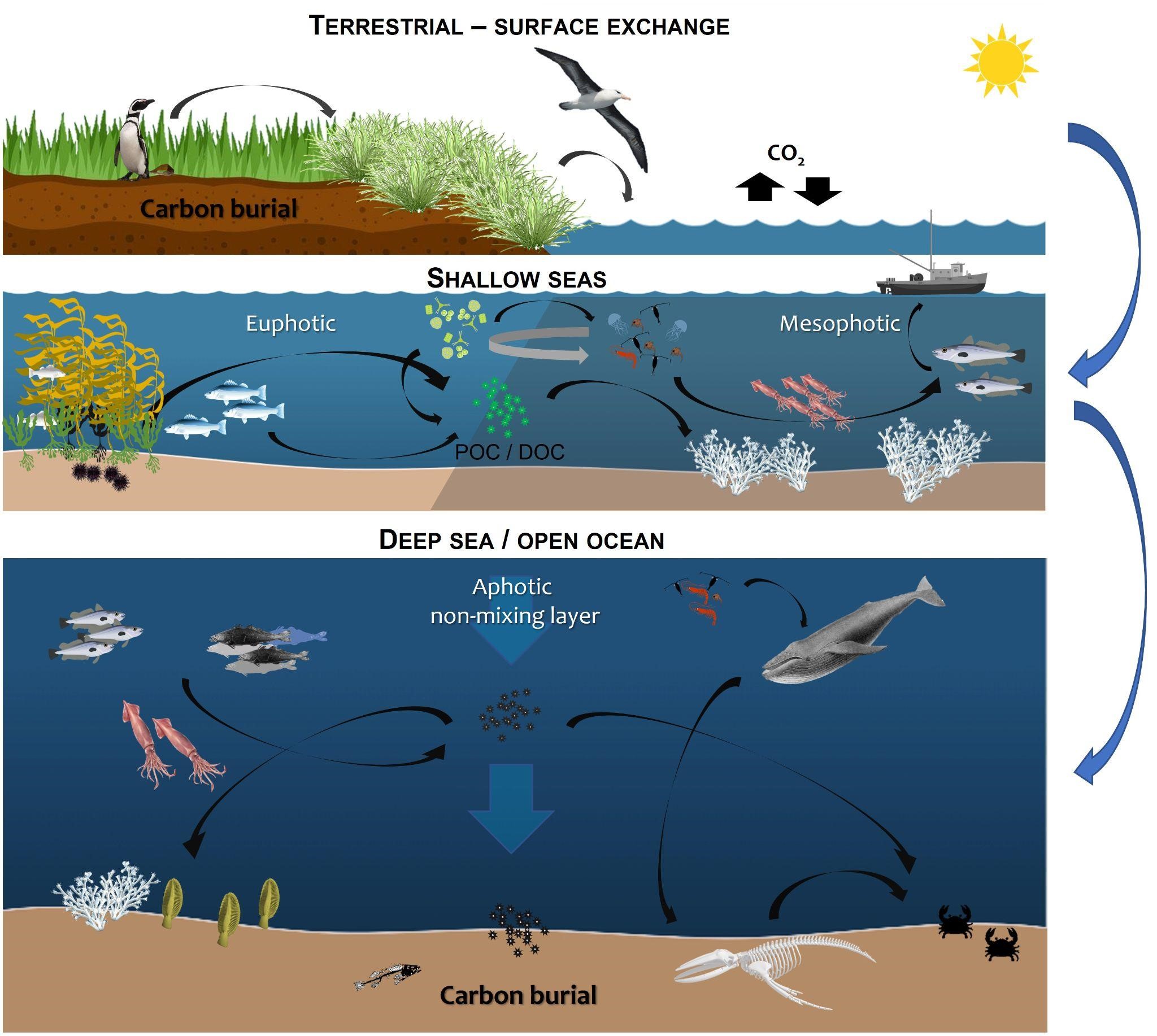
The marine environments of the Falkland Islands are spectacular – they support rich and diverse ecosystems, globally significant populations of seabirds and marine mammals and rich inshore environments, including some of the world’s densest giant kelp forests. These kelp forests cover the Falklands coastal zones protecting the islands from sub-Antarctic storms, providing nursery grounds for commercial and non-commercial fin-fish and squid species – and linking key trophic cascades across the carbon cycle ‘blue carbon’ (Figure 1).
Figure 1. Overview of blue carbon habitats considered in the Falkland Islands including tidal marsh, mud flats and terrestrial input, kelp forests, the mesophotic zone (30 – 150 metres) and seafloor (carbon storage and sequestration potential). Source Bax et al., (2022)
There is an emerging basis for blue carbon research in the Falkland Islands through new collaborative research led by Dr Narissa Bax from the South Atlantic Environmental Research Institute (SAERI), which seeks a broader understanding of Falkland Islands Blue Carbon as a tool to inform future marine spatial planning. Published this month in the journal Frontiers in Marine Science research topic – Blue Carbon: Beyond the Inventory: https://www.frontiersin.org/articles/10.3389/fmars.2022.872727/full
Locations like the Falkland Islands represent some of Earth’s most unexplored environments and present a rare opportunity to explore novel, unimpacted marine habitats that have genuine climate change mitigation potential, according to the new joint SAERI-British Antarctic Survey (BAS)-led study.
In the current planetary emergency, caused by global biodiversity loss and rapid climate change, intact ecosystems are increasingly rare and predominantly found only in remote corners of the world.
The study proposes a multi-tier process to marine spatial planning by incorporating knowledge on carbon storage and sequestration to inform policy outcomes. The study involved a major collaborative effort spanning 13 institutes across 5 countries.
“Proposed Marine Managed Areas (MMAs) are being consulted upon in 2022 and if implemented would encompass 15% of Falkland Islands marine waters (67,000 km2). These areas host important blue carbon stores. This paper provides a foundation for future work on these globally significant ‘marine wilderness areas’ to safeguard the Falkland Islands blue carbon contributions for future generations” Dr Bax said.
The Falkland Islands MMAs are a significant development in the conservation of the Falkland Islands marine environment. The MMAs will protect near pristine marine wilderness areas that have little or no fishing impact, have irreplaceable globally important biodiversity and are ecologically representative of the Falkland Islands marine ecosystems, through a legal framework for protection.
Known as ‘Blue carbon’, the oceans natural process of carbon storage and sequestration in marine habitats removes significant CO2 from the atmosphere. The conservation of marine habitats that facilitate carbon dioxide removal from the carbon cycle, are a vital ecosystem service.
As the need to meet global targets limiting climate change takes center stage, governments are recognising that simply cutting emissions is not nearly enough and protecting in-tact blue carbon habitats such as kelp forests and seafloor biodiversity is an important challenge which has largely been ignored in international agreements. This is set to change as recent global legislation includes international transactions in carbon reduction credits, and such approaches are predicted to create novel revenue from carbon markets in excess of 1 trillion USD by 2050.
Many habitats in the Falkland Islands have never been discussed in this context before and this study presents a number of first order estimates from the nearshore to the deep sea, including 1) fluvial transport of Dissolved Organic Carbon (DOC) for the Falklands rivers; 2) overall estimates of carbon stock across the Falklands Conservation Zones; 3) the first specific discussion of the Falklands mesophotic ecosystems and knowledge gaps in the region; 4) a synthesis of offshore multibeam bathymetry data and vulnerable marine ecosystem (VME) distribution and areal extent for the Falklands; and 5) a proposal that Falklands wetlands could be potential new local blue carbon habitats.
This approach focuses on ecosystem based preservation [not restoration, unless needed], as it is far more efficient and less costly to protect habitats while healthy than to restore once degraded, with compromised carbon storage and sequestration capabilities.
What is imperative to climate change mitigation is the long-term removal of CO2 from the carbon cycle for 100s of years if not more. This usually only occurs when animals die and they are buried below oxic layers of sediment on the seafloor [the site of long-term sequestration].
“Long-term CO2 removal is important for not only the healthy functioning of the carbon cycle, but also in terms defined by the United Nations representing global criteria to bring blue carbon into policy” Dr Bax highlighted.
Attempts to understand CO2 sequestration on the seafloor are so far expensive and small-scale, and large swaths of area have never been seen or sampled.
This limited spatial coverage presents a clear challenge and need for further investment to truly understand the climate mitigation potential of blue carbon habitats in combination with an increased understanding of the threats that could disturb the seabed and disrupt functional carbon sinks.
This approach links marine and terrestrial environments where carbon that would normally be locked away on land is instead lost to fluvial pathways and windblown deposition of particles into local rock pools with unknown consequences to the ocean-land blue carbon cycle.
Dr Bax further explained that “Spatial management is an important part of sustainable ocean futures, especially if we can keep pace with climate change and remain both locally and globally relevant’’
Whilst this paper focuses on knowledge gaps within the Falklands Conservation Zones, the Falklands also provide a unique global test-case for the necessity of protection and sustainable practice in jurisdictional waters – to mitigate the threat of unregulated fleets in Areas beyond National Jurisdiction (ABNJ).
“This approach could also pave the way for unique future incentives for conservation not only for Falkland Islands MMAs, but potentially across broad areas into the sub-Antarctic, to serve as an alternative to traditional marine protection frameworks which fail to remain adaptive to climate change and do not easily link to meaningful policy outcomes – outcomes that ultimately satisfy international commitments to protect life on Earth,” Dr Bax said.
Contact information: Email: info@saeri.ac.fk Phone: +500 27374 Information released by: The South Atlantic Environmental Research Institute, Falkland Islands
Used to determine whether a user is included in an A / B or Multivariate test.
18 months
_ga
ID used to identify users
2 years
_gali
Used by Google Analytics to determine which links on a page are being clicked
30 seconds
_ga_
ID used to identify users
2 years
_gid
ID used to identify users for 24 hours after last activity
24 hours
_gat
Used to monitor number of Google Analytics server requests when using Google Tag Manager
1 minute
_gac_
Contains information related to marketing campaigns of the user. These are shared with Google AdWords / Google Ads when the Google Ads and Google Analytics accounts are linked together.
90 days
__utma
ID used to identify users and sessions
2 years after last activity
__utmt
Used to monitor number of Google Analytics server requests
10 minutes
__utmb
Used to distinguish new sessions and visits. This cookie is set when the GA.js javascript library is loaded and there is no existing __utmb cookie. The cookie is updated every time data is sent to the Google Analytics server.
30 minutes after last activity
__utmc
Used only with old Urchin versions of Google Analytics and not with GA.js. Was used to distinguish between new sessions and visits at the end of a session.
End of session (browser)
__utmz
Contains information about the traffic source or campaign that directed user to the website. The cookie is set when the GA.js javascript is loaded and updated when data is sent to the Google Anaytics server
6 months after last activity
__utmv
Contains custom information set by the web developer via the _setCustomVar method in Google Analytics. This cookie is updated every time new data is sent to the Google Analytics server.
2 years after last activity
Google reCAPTCHA helps protect websites from spam and abuse by verifying user interactions through challenges.
Name
Description
Duration
_GRECAPTCHA
Google reCAPTCHA sets a necessary cookie (_GRECAPTCHA) when executed for the purpose of providing its risk analysis.
179 days
Marketing cookies are used to follow visitors to websites. The intention is to show ads that are relevant and engaging to the individual user.
Google Maps is a web mapping service providing satellite imagery, real-time navigation, and location-based information.